Sunday, March 28, 2010

Putting the Tar in the Tar Heel 200, March 27, 2010


Great news for Tar Heel 200 Permanent riders who last year amassed over 8,500 miles on their bikes between Benson and Tar Heel, NC. Anyone who has ridden the route knows that by far the most uneven pavement is located on River Road in Bladen County.

In mid-winter, there had been hints that River Road might be getting resurfaced. Those of us who regularly ride the route hoped it was true and not just wishful thinking.

Andy was the first to notice the possibility in the middle of February, when he noticed blacktop shoulders had been added. In a hilarious spoof, he referred to them as "bike lanes." He also pondered whether it was a harbinger of a badly needed resurfacing project. A spoof is one thing, but don't tease us, Andy!

A week later, I noticed a short stretch of road which was completely resurfaced as well as a slew of paving vehicles lined up alongside the road. Could it be true? We certainly hoped so.

Well, yesterday I got a first-hand view of the progress. Maria had floated an inquiry in my direction to ride Saturday. It turns out we had different but mutually compatible goals. Maria was hoping to test her fleche bicycle, while I was hoping for a riding buddy with whom to get in some more pre-fleche practice miles. As we approached the Bladen County line, I couldn't believe my eyes. Was it a mirage? Had the road been widened and resurfaced?

Later on down the road, we approached the crew in the middle of resurfacing even though it was a Saturday.

The sleek new pavement has got to be good for an additional 2-3 mph with the noticeably reduced rolling resistance.
It appears that the new layer of asphalt is about three inches thick. With ever the eye of the artist, Maria commented that the only thing that would be missed would be the tar snakes.

The possiblity of doing a night-ride this summer (mentioned by Andy) has greatly increased, since cyclists need not be concerned about rough pavement.

I borrowed the lead-in picture from the River City Cycling Club of Elizabeth City, NC.


Thanks for the entertaining company, Maria. I probably would not have ridden yesterday alone.

Let's ride!

Thursday, March 25, 2010

Phil Wood and the Sealed Bearing


I just saw a news item indicating Phil Wood recently died. Cyclists will recognize that name from the many high quality sealed bearing bicycle components with the "Phil" signature on them.

Woods' obituary is online here. An excerpt:

According to Peter Enright, who bought Phil Wood & Co., in 1991, bicycle hubs and brackets had not changed much in over a century. They were basically ball bearings placed in a cup and held in line by a pressed-in cone, which loosened easily. Wood invented a grooved hub in which ball bearings could be held in precisely by a screw-on cap. Except for the cheapest bikes, most bicycles today come with sealed hubs and bottom brackets that keep in lubricants and keep out water and grime.

However, Wood did not patent his invention and never got rich.

"My dad was an inventor," Williams said, "but he was not a businessman. He didn't care about those things. He just wanted to improve his inventions even more."
I got my first set of Phil hubs in 1974, and I still have them (pictured above with a modern rim). Way back when, we were dumbstruck by the idea of sealed hubs and bottom brackets. I loved repacking my Campy hubs, but these new Phil hubs were an evolutionary step forward. I'm sure someone will challenge that Phil was the inventor of sealed bearings, but I can attest to the fact that at the time they were not widely available in other bike parts.

As the obit notes, sealed hubs and other components are everywhere today, and we take them for granted. But some of us remember the day when things changed...

Thanks, Phil, we owe ya for millions of trouble-free miles.

Monday, March 22, 2010

Ha! Siler City Express 200K

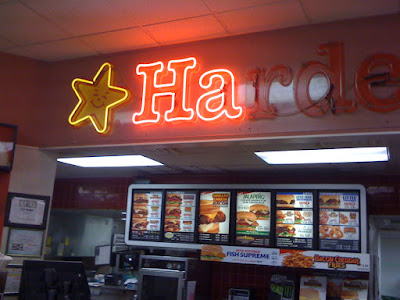
McDonald's may have their happy meal but Hardee's has em beat with this new improved sign, spotted yesterday on the Siler City 200K.


Siler City is our hardest 200K permanent, with a mercifully short 18 percent grade on the return leg. We did lots of chitchatting on yesterday's ride. The things you learn about your buddies -- two of yesterday's riders have lost a total of 163 pounds through diet and exercise. Both kicked serious booty on the course. They make us proud.

Here's a photo of two relatively new riders, Tim and John O, from Wilson and Nash counties. Watching them come through the Uwharries yesterday, you'd never have suspected most of their riding is in the flatlands.


A couple more nods: Geof, showing remarkably good early season form, showed us the way up every hill but one. JoeRay demonstrated his keen botanical knowledge by giving us the Latin name of a tulip magnolia.
Thanks to Jack W for organizing. Here he is, a lot less surly than his bike:


Here are the boys coming through the Uwharries...


And enjoying break time...


Thanks to all for a fun day on the bikes.

Saturday, March 20, 2010

You are so DQ -- Black Creek Grocery is open!


Haha! That e-mail message was waiting for me as I wrapped up a fabulous day on the bikes doing the Black Creek 200K permanent. Smart phones have opened up a new loading dock of possibilities for smack talk among your riding buddies, even when 25 miles of pavement separate you.

A full explanation is in order, but first, let me say it was a spectacular day for riding in North Carolina. Today is the first day of spring and it sure looked like it. The world went boom and bloomed, trees, bushes, flowers, even the fallow fields along the course sported a shag carpet of purple flowers. People everywhere were out in their yards trying to start lawn equipment they'd parked in the shed last fall, and everybody's dogs were out and about and ready for the chase.

Along for the ride today were Bob, Mike O, Fearless Leader Al, Dean, Lynn and myself. We'd hoped to have one guest rider from out of town but she developed a cough and sent her regrets. A special congrats to Mike O who wrapped up his R-12 upon completing today's course. Here he is:


Also, we're running a picture of Al since we neglected to put one up last Sunday on his birthday ride:


My Coho has a bad bearing in the bottom bracket and I'm waiting for the replacement part so I rode my other bike today, an immaculate cream-colored McLean made in 1979.


It's so clean that I only ride it on days when the chance of rain is zero and the pollen count is low. The original owner put very few miles on it and it came to me with everything, including tires and tubes, that it had when it rolled out of Dale Brown's shop three decades ago. The tires, tan-wall Michelins, look suspect. Dry rot. I guess they're good for a few more rides but I'm waiting for a side wall to crack open and explode, so every pedal stroke is an adventure.

Okay, back to the story. The town of Black Creek in Wilson County is the turnaround point and the only store in town, Black Creek Grocery, serves as the control. Lynn and I were out in front most of the day and reached the Grocery at 11:11. The "Open" sign was black. We tried the police station and the town hall. All locked up.

We saw the the rest of our group still motoring east and I stopped them to let them know the Grocery was closed. I told them to use the business next door (Brill's Upholstery) as an information control. And away we went.

When Lynn and I got back to the ride start, I checked my e-mails and found that fun note from Sridhar with that great photo. I love those guys.

Another great day on the bikes.

Monday, March 15, 2010

Announcing A Sea Change

Wow. Am I still in the U.S.?

First, Secretary of Transportation Ray LaHood, United States Secretary of Transportation climbs on a table at the recent National Bike Summit to thank the crowd and show his support for bicycling and walking.

Here he is.


Then he writes on his blog:

I want to announce a sea change. People across America who value bicycling should have a voice when it comes to transportation planning. This is the end of favoring motorized transportation at the expense of non-motorized.

We are integrating the needs of bicyclists in federally-funded road projects. We are discouraging transportation investments that negatively affect cyclists and pedestrians. And we are encouraging investments that go beyond the minimum requirements and provide facilities for bicyclists and pedestrians of all ages and abilities.


And then he releases this policy statement:

United States Department of Transportation
Policy Statement on Bicycle and Pedestrian Accommodation
Regulations and Recommendations
Purpose

The United States Department of Transportation (DOT) is providing this Policy Statement to reflect the Department’s support for the development of fully integrated active transportation networks. The establishment of well-connected walking and bicycling networks is an important component for livable communities, and their design should be a part of Federal-aid project developments. Walking and bicycling foster safer, more livable, family-friendly communities; promote physical activity and health; and reduce vehicle emissions and fuel use. Legislation and regulations exist that require inclusion of bicycle and pedestrian policies and projects into transportation plans and project development. Accordingly, transportation agencies should plan, fund, and implement improvements to their walking and bicycling networks, including linkages to transit. In addition, DOT encourages transportation agencies to go beyond the minimum requirements, and proactively provide convenient, safe, and context-sensitive facilities that foster increased use by bicyclists and pedestrians of all ages and abilities, and utilize universal design characteristics when appropriate. Transportation programs and facilities should accommodate people of all ages and abilities, including people too young to drive, people who cannot drive, and people who choose not to drive.

Policy Statement

The DOT policy is to incorporate safe and convenient walking and bicycling facilities into transportation projects. Every transportation agency, including DOT, has the responsibility to improve conditions and opportunities for walking and bicycling and to integrate walking and bicycling into their transportation systems. Because of the numerous individual and community benefits that walking and bicycling provide — including health, safety, environmental, transportation, and quality of life — transportation agencies are encouraged to go beyond minimum standards to provide safe and convenient facilities for these modes.

Authority

This policy is based on various sections in the United States Code (U.S.C.) and the Code of Federal Regulations (CFR) in Title 23—Highways, Title 49—Transportation, and Title 42—The Public Health and Welfare. These sections, provided in the Appendix, describe how bicyclists and pedestrians of all abilities should be involved throughout the planning process, should not be adversely affected by other transportation projects, and should be able to track annual obligations and expenditures on nonmotorized transportation facilities.

Recommended Actions

The DOT encourages States, local governments, professional associations, community organizations, public transportation agencies, and other government agencies, to adopt similar policy statements on bicycle and pedestrian accommodation as an indication of their commitment to accommodating bicyclists and pedestrians as an integral element of the transportation system. In support of this commitment, transportation agencies and local communities should go beyond minimum design standards and requirements to create safe, attractive, sustainable, accessible, and convenient bicycling and walking networks. Such actions should include:

Considering walking and bicycling as equals with other transportation modes: The primary goal of a transportation system is to safely and efficiently move people and goods. Walking and bicycling are efficient transportation modes for most short trips and, where convenient intermodal systems exist, these nonmotorized trips can easily be linked with transit to significantly increase trip distance. Because of the benefits they provide, transportation agencies should give the same priority to walking and bicycling as is given to other transportation modes. Walking and bicycling should not be an afterthought in roadway design.

Ensuring that there are transportation choices for people of all ages and abilities, especially children: Pedestrian and bicycle facilities should meet accessibility requirements and provide safe, convenient, and interconnected transportation networks. For example, children should have safe and convenient options for walking or bicycling to school and parks. People who cannot or prefer not to drive should have safe and efficient transportation choices.

Going beyond minimum design standards: Transportation agencies are encouraged, when possible, to avoid designing walking and bicycling facilities to the minimum standards. For example, shared-use paths that have been designed to minimum width requirements will need retrofits as more people use them. It is more effective to plan for increased usage than to retrofit an older facility. Planning projects for the long-term should anticipate likely future demand for bicycling and walking facilities and not preclude the provision of future improvements.

Integrating bicycle and pedestrian accommodation on new, rehabilitated, and limited-access bridges: DOT encourages bicycle and pedestrian accommodation on bridge projects including facilities on limited-access bridges with connections to streets or paths.

Collecting data on walking and biking trips: The best way to improve transportation networks for any mode is to collect and analyze trip data to optimize investments. Walking and bicycling trip data for many communities are lacking. This data gap can be overcome by establishing routine collection of nonmotorized trip information. Communities that routinely collect walking and bicycling data are able to track trends and prioritize investments to ensure the success of new facilities. These data are also valuable in linking walking and bicycling with transit.

Setting mode share targets for walking and bicycling and tracking them over time: A byproduct of improved data collection is that communities can establish targets for increasing the percentage of trips made by walking and bicycling.

Removing snow from sidewalks and shared-use paths: Current maintenance provisions require pedestrian facilities built with Federal funds to be maintained in the same manner as other roadway assets. State Agencies have generally established levels of service on various routes especially as related to snow and ice events.

Improving nonmotorized facilities during maintenance projects: Many transportation agencies spend most of their transportation funding on maintenance rather than on constructing new facilities. Transportation agencies should find ways to make facility improvements for pedestrians and bicyclists during resurfacing and other maintenance projects.

Conclusion

Increased commitment to and investment in bicycle facilities and walking networks can help meet goals for cleaner, healthier air; less congested roadways; and more livable, safe, cost-efficient communities. Walking and bicycling provide low-cost mobility options that place fewer demands on local roads and highways. DOT recognizes that safe and convenient walking and bicycling facilities may look different depending on the context — appropriate facilities in a rural community may be different from a dense, urban area. However, regardless of regional, climate, and population density differences, it is important that pedestrian and bicycle facilities be integrated into transportation systems. While DOT leads the effort to provide safe and convenient accommodations for pedestrians and bicyclists, success will ultimately depend on transportation agencies across the country embracing and implementing this policy.


Let's celebrate. Anybody up for a bike ride?

Wednesday, March 10, 2010

Google Announces Biking Directions

Following is a press release from the League of American Bicyclists:

Washington, D.C. - March 10, 2010 - The League of American Bicyclists is proud to be the forum for Google to announce what all bike riders have been waiting for - Grab Your Bike and Go with Google Maps. Google is announcing at the Opening Plenary Session at the National Bike Summit that they are adding biking directions in the U.S. to Google Maps."This new tool will open people's eyes to the possibility and practicality of hopping on a bike and riding," said Andy Clarke, President of the League of American Bicyclists. "We know people want to ride more, and we know it's good for people and communities when they do ride more - this makes it possible. It is a game-changer, especially for those short trips that are the most polluting,"

Users can now choose biking when deciding how to get to their destination, starting today, March 10, 2010. If you're one of the 57 million Americans who ride a bike, mapping your daily commute, and planning recreational or trail rides just became easier. According to Google this has been the most requested addition to Google Maps, and the League is delighted that they have chosen the National Bike Summit to unveil this new feature. Google's announcement further proves the importance of the Summit and the bicycle movement in helping our nation become a more Bicycle Friendly America. The Google biking directions will make it that much easier for bicyclists to get to work, school or play.

This new feature includes: step-by-step bicycling directions; bike trails outlined directly on the map; and a new "Bicycling" layer that indicates bike trails, bike lanes, and bike-friendly roads. The directions feature provides step-by-step, bike-specific routing suggestions - similar to the directions provided by our driving, walking, or public transit modes. Simply enter a start point and destination and select "Bicycling" from the drop-down menu. You will receive a route that is optimized for cycling, taking advantage of bike trails, bike lanes, and bike-friendly streets and avoiding hilly terrain whenever possible.

Visit http://maps.google.com/biking to try out this new feature. Biking directions for Google Maps is currently in Beta. Follow the League's news feed on the new Google feature on the League's Blog, Facebook and Twitter. If you have any further questions, contact Meghan Cahill at 202.822.1333 or meghan@bikeleague.org.


This is great news, and hopefully it will avoid some of the routing issues that came up when using "Walking Directions," like this cue on a ride I routed last summer to Sunset Beach, NC. I suspect some of you Dirt Road Randonneurs would thoroughly enjoy this option.


One nice feature: Google maps now shows bike routes in major cities, including Raleigh. Look at the map below and you'll see city greenways in dark green and cycling routes in a lighter green:


Of course, there may be a few kinks to work out. I just tried routing from Raleigh up to Clarksville, Virginia, a town the Lake Loop passes through. Google biking directions put me on a 15-mile stretch of Capital Blvd, a major artery into and out of Raleigh and possibly the worst cycling road in our area. Have a look:

Sunday, March 7, 2010

NC 400K / March 6/ 2010 / A Coastal Tour

Maybe we've seen the last of our winter rides for this season. I hope so. Putting on 25 pounds of wool every time we go for a ride is starting to get old. The temperatures on Saturday's 400K started at 33, climbed to 55 at mid day then jumped off a cliff into the mid 20s after the sun quit the sky. It wasn't supposed to get below 33 for the evening. But my frozen water bottle tells no lies.

Tony Goodnight, one of the NC RBAs, put on a fantastic event -- or pair of events -- yesterday. For those looking to go long, the 400K was the obvious choice. Or you could break that up into a pair of 200Ks and spend the night at Atlantic Beach.

Tony lives in the middle part of the state but has been opening up new early season territories by taking riders east to the coast. This is the second ride of the year where we got to see the ocean and smell salt air and fried seafood. Yesterday's ride started in Wallace, NC, about 60 miles from the coast and meandered through several coastal towns, including Beaufort, Morehead City, Emerald Isle and Surf City. Everything east of I-95 in North Carolina lies in the coastal plain; several flyover bridges provided the only hills.


Here's the top of the bridge into Atlantic Beach. I'll call this an art shot since it's so out of focus.

Flat rides are tough because you're always pedaling and you're always sitting on your tookus. I wisely slathered on the Lantiseptic at the ride's start and never had any issues.

When you ride down east in NC, sooner or later you're going to run into some big-ass body of water that needs crossing. Historically, many of the crossings were by private ferry. Ferries still serve an essential transportation role but now the state runs them, including the one we took on Saturday's event, a 20-minute ferry ride at Minnesott Beach, where we crossed a broad stretch of the Neuse River. Ferries on brevets may be old hat for the folks in the Seattle area, but it was a first for me on an NC brevet, and it proved to be a pleasant diversion. I looked up the schedule before the ride and saw that it ran every 30 minutes, on the :15 and :45. This bit of knowledge came in handy. When our group got overly excited and ramped up the pace to about 23 mph, Carol and Ende and I sat up. We dropped back to a leisurely conversational pace. We'd done the math -- try as they might, the front group would miss the 1:15 ferry and end up on the same boat as us, at 1:45.

The ferry ride was the perfect time for a lunch break. However, with no restaurants nearby we thought we'd be eating nabs out of the vending machine. Then Tony showed up, just before we boarded, with bags of Subway sandwiches. Ever seen sea gulls swarm the back of a shrimp boat? Here's the rando equivalent at a food source.


A tired rider? Nope, that's Tim from Wilson, doing his best impression of a snake on a rock. He was taking advantage of the sun soaking the ferry deck. Either that, or it's a case of Yoohoo poisoning. Tim lives on that drink.

Here are other riders enjoying our forced break.


Our ferry ride over, we rolled through the lowlands and swamplands, enjoying a slight trailing breeze in our run into Beaufort and Morehead City. The best part about yesterday's ride was our peloton. Ten of the riders on the 400K managed to hang together for nearly the entire ride. That gave me a chance to chat up Keith on his Surly (he has a ride report here) and one of the newer riders, Tim from Wilson, who put in some tremendous efforts on the front. We also had Tom and Mary, Lynn, Carol, Capn Ende, Jimmy and Steven (aka "The Smile Doctor"). Early in the ride we lost Joel, Jerry, Dean, Lin, Gary and Paul, but we passed them in the dark of the night on an out-and-back portion of the route near Surf City.

We had one mechanical along the way. As we rolled into the control at Bogue Inlet Pier near Emerald Isle....


...Capn Ende's right SPD pedal fell slap off the spindle. The bearings were shot. Here he is the moment the pedal failed.


The end of Ende's day? Nope. He located a bike shop about a mile away. Although it was right at closing time, the shop owners waited for him and installed new pedals. The rest of us plowed through piping hot plates of Chinese food at the restaurant a block from the pier. Ende joined us about 15 minutes later, his bike ready to roll once again.

Here, the crew stares across the ocean. If they squint, they can almost see PBP 11.


By my count, our front group had, let's see... 1, 2, 3...4 doctors or dentists. Forty percent. Since percentages are easy with 10 as a denominator, here are a few more: PBP finishers -- 50 percent; LEL finishers -- 30 percent; PAC Tour participants -- 20 percent; Cascade 1200K finishers -- 30 percent; RAAM-qualified riders -- 20 percent; Super Randonneurs -- 90 percent; Women riders -- 30 percent.

Another fine day on the bikes, but by day's end we were all glad to get out of the bitter cold and into something warmer, like a hot shower or a car with the heat cranked.

Quote of the ride, at the Chinese restaurant, with 150 miles down, 100 miles to go: "We've just about got this fish in the boat."

Best improvised cold-weather gear: The bubble wrap that Mary, Tom and Lynn stuffed in the front of their shorts and jerseys for a bit more insulation from the cold.

Wednesday, March 3, 2010

NAHBS Report (not mine) & Pix (not mine)

We had a fine time at the Handmade Bike Show, and getting there was half the fun. Chuck Lathe of Coho Bikes was an exhibitor and did a nice write-up. You can see it here. I'm with Chuck when he says the people were the best part.

I talked to some fantastic builders, like Eric Keller, a PA framebuilder and randonneur, Tom Palermo of MD and Mills Brothers from right here in NC. I got up early Sunday and went downstairs to the lobby for a coffee and sat down for a half-hour with builder Peter Weigle. We talked about the magic in certain frames, and the trend to do creative restoration of old bikes.

Dale Brown of Cycles De Oro in Greensboro took tons of photos. Check them out here.